
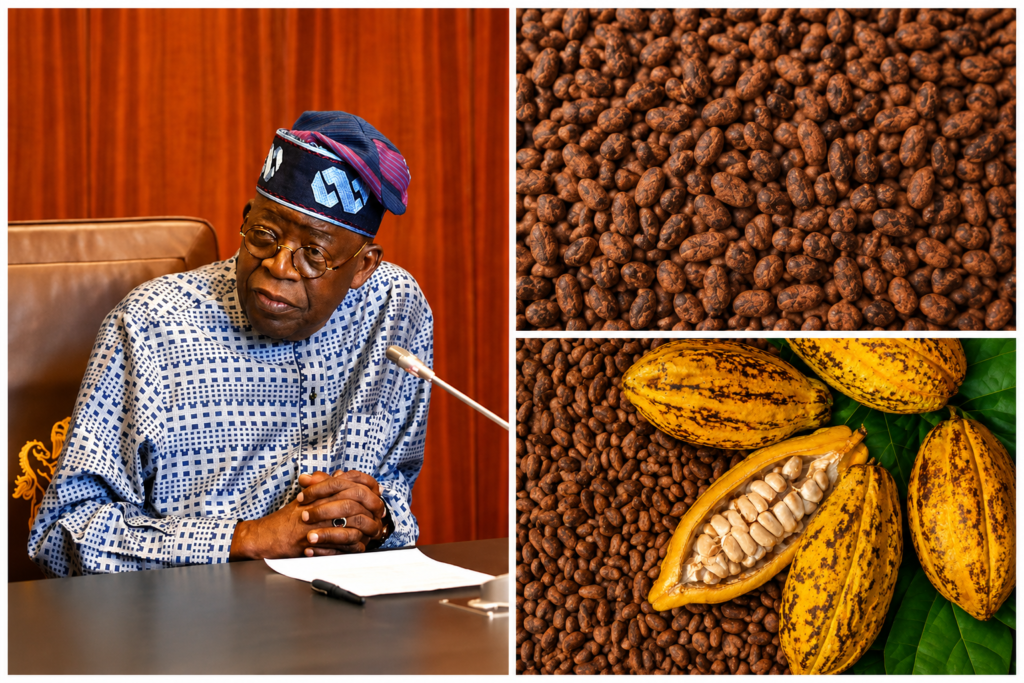

The Federal Government has announced plans to ban the export of raw cocoa beans as part of a broader strategy to strengthen Nigeria’s cocoa industry through local processing and value addition.
President Bola Ahmed Tinubu disclosed the policy at the Cocoa Value Addition Summit 2026, represented by the Minister of Agriculture and Food Security, Senator Abubakar Kyari.
The policy is expected to stimulate domestic investment in cocoa processing, create jobs, and boost Nigeria’s earnings from the global cocoa value chain. It also underscores the Tinubu administration’s commitment to repositioning the agricultural sector from exporting raw commodities to driving industrial processing, value addition, and manufacturing.
According to Punch, The summit, themed “From Bean to Brand: The Bean in My Hand, The Brand in Our Future,” had in attendance ministers, governors, development partners, financiers, representatives of cocoa-producing countries, and investors from across Africa.
The gathering marked the launch of a strategic blueprint aimed at boosting local cocoa processing, increasing value addition, attracting investment, and strengthening Africa’s position in the global cocoa industry.
Under the proposed policy, cocoa producers and exporters must process cocoa beans into finished and semi-finished products including cocoa butter, cocoa powder, cocoa liquor, chocolate, and other value-added products before exporting them. The policy aims to strengthen local processing, increase export value, and reduce reliance on raw cocoa exports.
The government believes this will enable Nigeria to earn significantly more from its cocoa industry than it currently does through the export of unprocessed beans.
Tinubu further added that Nigeria is one of Africa’s leading cocoa-producing nations, but the country exports most of its cocoa in raw form. An action which has allowed the foreign manufacturers to reap the greater economic benefits from processing. He maintained that increasing local processing capacity will help diversify the economy, reduce dependence on crude oil revenues, and position Nigeria as a major exporter of finished cocoa products.
However, Stakeholders have largely welcomed the policy, describing it as a step toward industrialisation and sustainable economic growth. Also industry experts have stressed that the success of the initiative will depend on adequate infrastructure, stable electricity supply, access to finance, and incentives for local processors to compete effectively in the international market.
The proposed ban forms part of the Tinubu administration’s broader economic agenda to promote local production, enhance value addition, and maximise the country’s agricultural potential.