
The Federal Government is considering a law to protect Nigeria’s economic reforms from being reversed by future administrations, Finance Minister Taiwo Oyedele has disclosed.
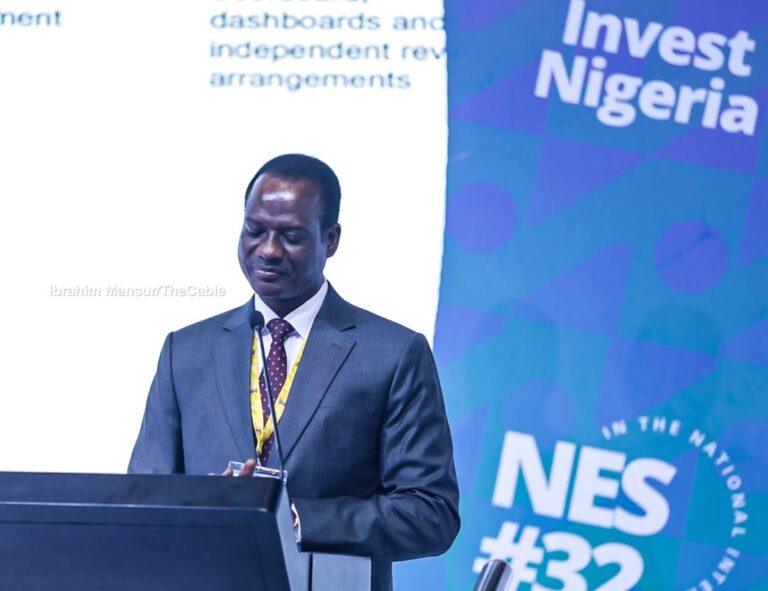
Oyedele made this known on Monday at the 32nd Nigerian Economic Summit in Abuja, themed “Growth that Works: Delivering Jobs, Productivity and Shared Prosperity.”
He said the government was seeking national agreement on an economic policy framework that could be backed by law to ensure consistency in decisions on taxation, tariffs, subsidies, investment and industrial development.
“We now need to lock it in, in institutions, in law, as well as policy framework, so that it can be enduring,” he said during a panel session.
FG Seeks to Protect Reforms
According to Oyedele, the proposal is intended to prevent future governments from abandoning economic reforms for short-term political gains, particularly the removal of petrol subsidies.
He said the proposed framework would also help strengthen institutions and guide future policy decisions.
“Any ideas of returning it, we should forget about it,” the minister said, referring to the possibility of restoring petrol subsidies.
Read also: N10bn Ebola Fund Also Covers Lassa Fever, Other Diseases – NCDC
He added that the government was considering making the framework part of the screening process for political appointees, with officials expected to understand and comply with the agreed economic principles.
However, Oyedele clarified that the Nigeria Economic Policy Framework was still a consultation draft and had not been approved as government policy.
Public consultation, he said, would continue until November 27, 2026, after which the document would be submitted to the Federal Executive Council for approval and the National Economic Council for endorsement.
Framework Targets Policy Consistency
Presenting the framework, Oyedele criticised Nigeria’s history of inconsistent economic policies, arguing that successive administrations had often undermined previous reforms.
“Policy uncertainty is an invisible tax on enterprise. And unlike most taxes, it generates no revenue for government; it only destroys value and discourages investment,” he said.
The proposed framework recommends mandatory Policy Impact Assessments before major economic interventions. Under the proposal, regulators would have to establish the evidence, costs, beneficiaries and expected duration of planned measures.
It also proposes an annual National Economic Scorecard, to be published by Independence Day, to measure changes in real wages, productive employment and poverty.
Oyedele said the framework would focus on stability, productivity, enterprise, capital, people, markets and institutions, with private businesses expected to drive growth under predictable regulations.
He further suggested that political parties could eventually focus on how they would implement an agreed national economic policy rather than presenting competing economic manifestos.
Minister Defends Petrol Subsidy Removal
On petrol subsidy, Oyedele maintained that artificially suppressing prices had distorted the economy and created problems that became more expensive to address.
He argued that the priority should be improving household incomes rather than keeping prices below sustainable market levels.
“Let’s not suppress prices. Let’s focus on raising income,” he said.
The minister also questioned Nigeria’s industrial protection policies, saying vehicles assembled locally contained only about five per cent local content despite benefiting from tariff and levy protection of up to 60 per cent.
He called for temporary, performance-based protection for domestic industries, alongside improvements in electricity, logistics and manufacturing competitiveness.
Oyedele also disclosed that the government was targeting low single-digit inflation before the end of 2027 to create conditions for single-digit interest rates, although he did not provide a definite timeline for cheaper borrowing.
Bagudu Rules Out Return to Subsidy
The Minister of Budget and Economic Planning, Abubakar Bagudu, backed the government’s reform agenda, saying President Bola Tinubu had directed officials to sustain the policies despite concerns about their immediate impact on households.
“There will be no return to subsidy. There will be no return to those distortions,” Bagudu declared.
He said the Federal Government had reached agreements with states on improved coordination of fiscal and monetary policies, infrastructure development, security and domestic production.
Bagudu added that more than $6bn had been mobilised from the World Bank and other development partners to support household resilience and economic opportunities.
Soludo, Experts Call for Stronger Growth
Also speaking at the summit, Anambra State Governor Charles Soludo warned against abandoning macroeconomic stability, stressing the need for sustained policy discipline.
“The macroeconomic framework, the stability that is back, must never be taken for granted,” he said.
However, Soludo argued that economic growth of about four per cent was insufficient to deliver rapid poverty reduction and job creation. He called for increased investment and faster expansion.
Oxford University Professor of Economic Policy, Stefan Dercon, also stressed the importance of controlling inflation, stabilising the economy and improving electricity supply, logistics and port operations.
He cautioned against indefinite protection for local industries, saying, “You can’t keep on protecting in the same way.”
Similarly, Chema Triki, co-founder and managing director of Growth Teams, said Nigeria needed to develop new productive capabilities and expand exports rather than depend excessively on its domestic market.
She cited the country’s low economic complexity ranking and limited export diversification as reasons to strengthen industrial competitiveness.
Business Leaders Seek Lower Costs
The Group Managing Director of Flour Mills of Nigeria, Omoboyede Olusanya, called for lower interest rates, reliable infrastructure and improved agricultural productivity to reduce manufacturing costs.
He said expensive financing discouraged long-term investment, while poor logistics and unstable commodity supplies weakened domestic industries.
Meanwhile, Lagos State Governor Babajide Sanwo-Olu highlighted investments in ports, transport corridors, rail infrastructure and food logistics as measures to improve productivity and reduce business costs.
The Chairman of the Nigerian Economic Summit Group, Olaniyi Yusuf, urged the government to ensure that reforms translated into affordable living costs, productive employment and measurable improvements in household welfare.
The Minister of State for Budget and Economic Planning, Doris Uzoka-Anite, also said the National Development Plan 2026–2030 would prioritise industrialisation, infrastructure, investment mobilisation, human capital development and stronger institutions.
She said the plan aimed to accelerate economic growth, create more jobs and reduce poverty through better coordination of government policies, budgets and investment programmes.