
The Nigeria Labour Congress (NLC) and the Trade Union Congress of Nigeria (TUC) have resolved their disagreement over the Federal Government’s proposed ₦70,000 six-month transport allowance for workers.
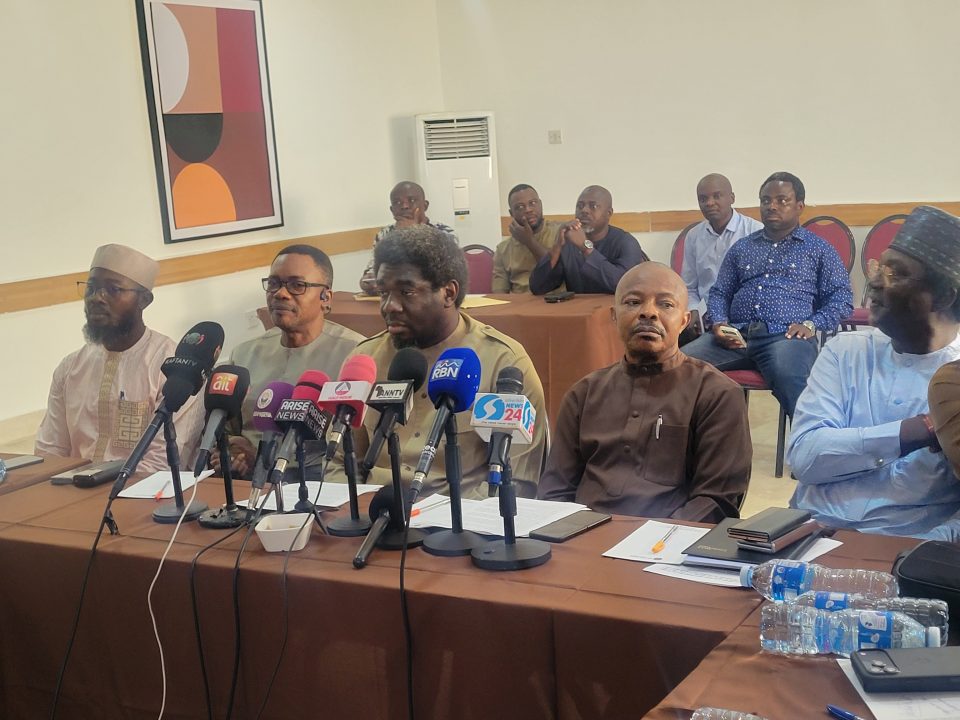
The two labour centres announced the resolution on Wednesday at a joint press conference in Abuja, saying they had agreed to put their differences aside in the interest of Nigerian workers.
In a joint statement signed by NLC President Joe Ajaero and TUC President-General Festus Osifo, the unions described the disagreement as a family misunderstanding that had been settled through the intervention of former leaders of both organisations.
Labour Leaders Agree to Set Aside Differences
The unions acknowledged that their disagreement had played out publicly but maintained that their shared responsibility to Nigerian workers was more important than their institutional differences.
“The unity of the Nigerian working class is far greater than any disagreement between leaderships. Our common struggle, shared history, and collective responsibility to defend workers’ rights must never be sacrificed on the altar of misunderstanding or institutional differences,” the statement read.
The dispute followed separate appearances by Ajaero and Osifo on Channels Television’s The Morning Brief, where they disagreed over which labour centre had the authority to negotiate with the Federal Government on behalf of workers.
Ajaero maintained that the NLC could negotiate independently, citing the principle of representation under the International Labour Organisation (ILO).
“TUC can negotiate along with NLC, but NLC can negotiate alone based on the principle of most workers’ representatives of the ILO,” he said.
Osifo, however, described the agreement announced by Ajaero as an aberration, arguing that the TUC was not involved in the negotiations.
He challenged the NLC president to identify any ILO regulation allowing one labour centre to negotiate on behalf of another without consultation.
NLC, TUC Disagree Over Representation
The TUC president-general argued that the NLC could not negotiate for workers represented by his organisation simply because it had more affiliated unions.
He maintained that both labour centres should participate in negotiations whenever the interests of their respective members were involved.
Ajaero, in response, cited the Trade Union Amendment Act 2005, which made trade union membership voluntary, and Section 40 of the 1999 Constitution, which guarantees freedom of association.
He also questioned the extent of TUC representation in the federal public service, arguing that only one TUC-affiliated union belonged to the Joint National Public Service Negotiating Council, which he said comprised eight union bodies.
According to him, seven of the eight unions were affiliated with the NLC, while the remaining union had placed its negotiating authority under the joint body.
Osifo also questioned the legitimacy of the meeting at which the transport allowance was agreed, insisting that it was not a formal meeting of the Joint National Public Service Negotiating Council.
Ajaero explained that the NLC had engaged the Federal Government after issuing an ultimatum over workers’ demands.
Read also: Army Explains Meeting With Armed Bandits in Kwara, Says 12 Rifles Recovered
He said the government requested four days to meet with the union, after which discussions resumed and the ₦70,000 allowance was introduced.
TUC Rejects Allowance, Seeks Salary Increase
The disagreement also centred on the TUC’s rejection of the proposed six-month transport allowance, with the union insisting that workers should receive a salary increase while negotiations on a new national minimum wage were concluded.
The TUC had restated its position during a meeting with the Federal Government chaired by the Secretary to the Government of the Federation, Senator George Akume.
The meeting followed a letter submitted by the union on October 8, 2026, titled “Request for an Urgent Meeting to Address Critical National Economic, Security, and Labour Challenges.”
In a statement issued after the meeting, TUC Secretary-General N.A. Toro said the government had approved the establishment of a high-powered committee to examine the concerns raised by the union.
The committee is expected to review the issues, assess actions already taken by the government and make recommendations on outstanding demands.
It comprises three TUC representatives and officials from the Office of the Secretary to the Government of the Federation, the Office of the Head of the Civil Service of the Federation, the National Salaries, Incomes and Wages Commission, and the Federal Ministry of Labour and Employment.
The committee is expected to begin work immediately and submit its report to the Secretary to the Government of the Federation within two weeks.