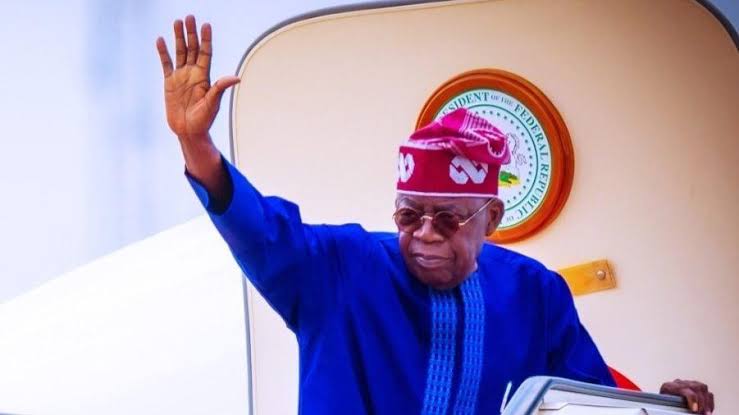

Nigeria’s President Bola Ahmed Tinubu has asked the Senate for permission to borrow a new $7.7 billion external loan to finance the 2026 budget deficit.
The request was contained in an October 26, 2026 letter read on the Senate floor on Wednesday 4, November 2026.
Per the letter, the loan will part-finance the Federal Government’s N31.4 trillion budget deficit for the 2026 fiscal year. The document highlighted that the request aligns with the 2026 Appropriation Act which approved N29.2 trillion in new borrowing.
The overall borrowing includes N18.4 trillion in domestic loans and N10.79 trillion in external financing. As such, the $7.7 billion request is expected to cover the external borrowing part of the appropriation act.
Notably, the loan values estimates the exchange rate at approximately N1,400 to the dollar. This places the naira value of the $7.7 billion at around N10.79 trillion.
According to Senate President Godswill Akpabio, the request effectively supersedes an earlier request for $20.3 billion. He explained that the new proposal provides more details and context about how the government intends to raise the funds.
“I believe this letter effectively supersedes the earlier request for 20.3 billion US dollars because the present request is more explicit. It also recognises that the borrowing will not necessarily come from one source,” he said.
He added that the administration will be expected to explore multiple funding options to choose ones with favourable terms.
Meanwhile, the letter revealed that the Tinubu administration intends to consider concessional and commercial loans from multilateral and bilateral institutions. Other sources include IMF facilities, bridge financing, direct borrowing from international financial institutions and eurobond issuance.
The administration stressed that the options will be pursued simultaneously, considering their costs, benefits and time required.
Regarding the purpose of the loans, the President stated that it will cover projects across several sectors. These include defense and security, transportation, agriculture, power, education, and healthcare.
He furthered that the loan will also support the country’s external reserves and the naira’s stability.