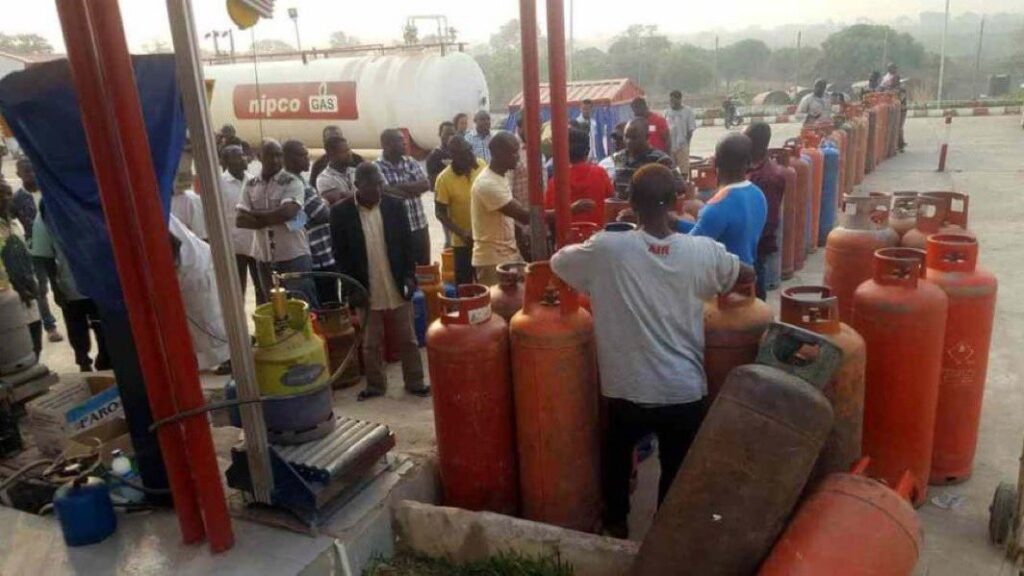

Cooking gas prices have risen to between ₦1,600 and ₦2,000 per kilogram in the Federal Capital Territory, forcing households to ration supplies or turn to alternative cooking fuels.
Residents who spoke with the News Agency of Nigeria (NAN) in Abuja on Sunday said the latest increase had made regular refills increasingly difficult amid rising living costs.
5kg Cylinder Refill Now Costs Up To ₦10,000
According to NAN, a 5kg cylinder currently costs between ₦8,000 and ₦10,000 to refill, while a 12.5kg cylinder goes for between ₦20,000 and ₦25,000, depending on the location and retailer.
Obi Nwosu, a resident of Gudu, said she could no longer afford to refill her cylinder at once and had resorted to buying smaller quantities based on the money available.
“Refilling my cylinder at N24,000 is no longer possible, especially with the rising costs of transportation and food,” she said.
She added that she now prioritised other expenses and purchased gas only in quantities she could afford.
Residents Turn To Charcoal, Reduce Gas Consumption
Another resident, Maimuna Idris, said she had started using a charcoal stove alongside cooking gas to reduce household expenses.
She explained that she reserved gas for some meals while using charcoal to prepare foods requiring longer cooking times, such as beans, and to boil water.
Read Also: Makinde Vows To Quit Politics If He Loses 2027 Election
Similarly, Asuquo Morgan, a resident of Karu, said he had reduced the quantity of gas he purchased because his income had not increased alongside the prices of essential commodities.
He urged the government to find a lasting solution to the rising cost, warning that households could be forced to return to using firewood.
Bidemi Ajayi, a resident of Lokogoma, also said she now bought gas in smaller quantities to manage her household budget.
Supply, Transportation Costs Blamed For Increase
NAN reported that cooking gas sold for between ₦1,360 and ₦1,700 per kilogram in the FCT in October, indicating a further increase in November.
Industry experts have previously attributed rising LPG prices to supply disruptions, higher transportation and logistics costs, foreign exchange volatility and developments in the international energy market.
The Nigerian Midstream and Downstream Petroleum Regulatory Authority has also identified inadequate domestic supply, low import volumes, poor distribution infrastructure and logistics challenges as factors driving prices upward.
In June, the Federal Government directed the NMDPRA and other relevant agencies to intensify surveillance and clamp down on marketers involved in hoarding and diversion of cooking gas.
The Minister of State for Petroleum Resources (Gas), Ekperikpe Ekpo, said the government was working to increase domestic supply, reduce dependence on imports and prioritise locally produced LPG for domestic consumption.