
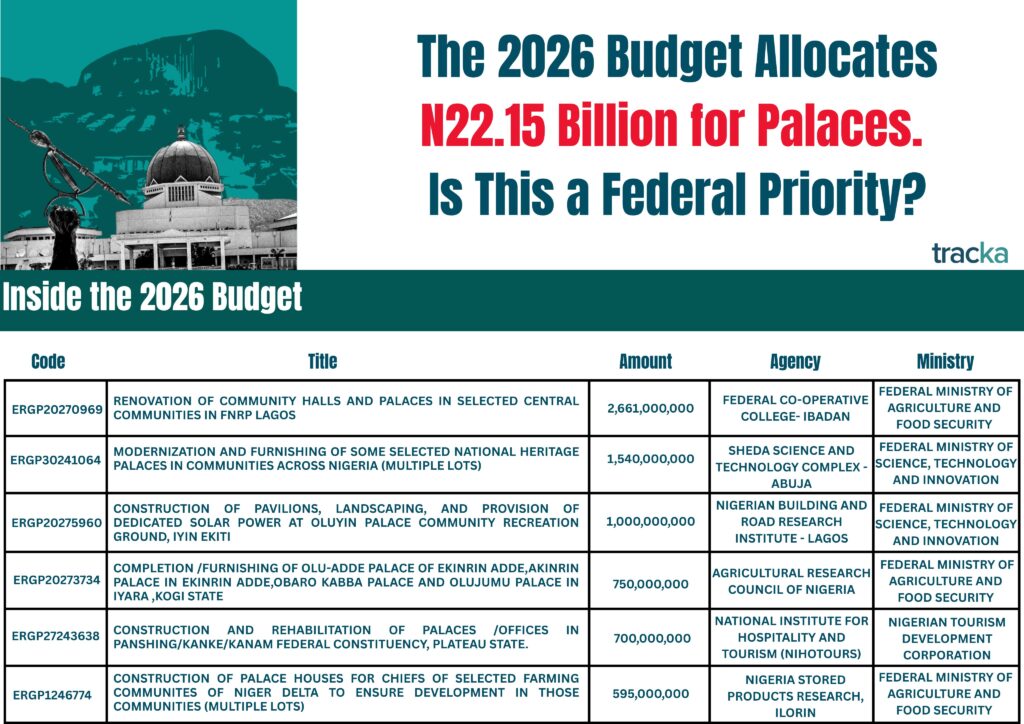

The Federal Government has proposed spending ₦22.15 billion on the construction, renovation and furnishing of 106 palaces across Nigeria in the 2026 budget, with an analysis revealing that 11 of the projects, valued at ₦5.85 billion, have no identified locations.
The findings were highlighted by Tracka, the civic technology platform of the BudgIT Foundation, which monitors public spending and government projects.
According to the analysis, the palace projects are spread across 45 federal Ministries, Departments and Agencies (MDAs), many of which have no constitutional or statutory responsibility for constructing or maintaining traditional institutions.
Tracka noted that the absence of locations for 11 of the projects raises serious accountability concerns, as citizens, civil society organisations and oversight bodies would find it difficult to verify whether the projects are eventually executed.
Allocated agencies
Among the agencies allocated funds for the palace projects are the Nigerian Building and Road Research Institute (NBRRI) with ₦3.92 billion, the Federal Cooperative College, Ibadan with ₦3.29 billion, the Sheda Science and Technology Complex with ₦1.54 billion, the National Cereals Research Institute with ₦427 million, the Industrial Arbitration Panel with ₦369.4 million, the National Oil Spill Detection and Response Agency (NOSDRA) with ₦280 million, and the Federal Neuro-Psychiatric Hospital, Dawanau with ₦42 million.
Tracka stressed that the concern is not about the importance of traditional institutions but about ensuring that public spending aligns with constitutional responsibilities, institutional mandates and Nigeria’s development priorities.
The organisation also observed that similar allocations have appeared in previous federal budgets, with agencies frequently assigned projects that fall outside their statutory functions.
The development follows earlier reports of unrelated constituency-style projects being inserted into the budgets of federal agencies, including research institutes and agricultural establishments, for projects such as classroom construction, markets, boreholes, health centres and solar streetlights.
Under the 1999 Constitution, traditional institutions are not recognised as a tier of government. Their establishment, recognition and regulation are governed by state chieftaincy laws, while local governments are constitutionally responsible for several community-based functions.
Although palaces play significant cultural and traditional roles, they are generally regarded as matters for state and local authorities rather than federal institutions whose mandates cover sectors such as defence, foreign affairs, customs, aviation and immigration.
The budget allocations have renewed calls for greater transparency and stricter adherence to constitutional mandates in the implementation of public projects.