
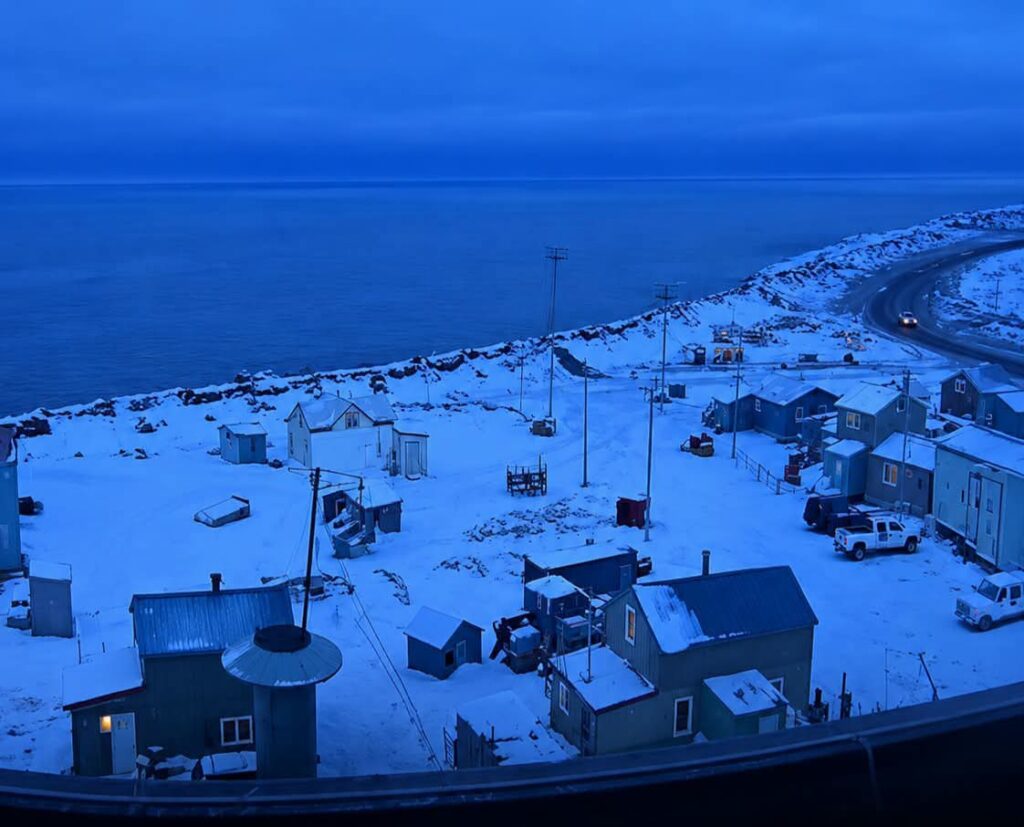

Imagine waking up every morning for more than two months without witnessing a sunrise. The sky never welcomes the day with golden rays, the familiar warmth of morning sunshine disappears, and the usual distinction between day and night becomes less obvious.
For residents of Utqiaġvik, a remote town in northern Alaska, this unusual experience is part of everyday life.
The town, recognised as the northernmost city in the United States, has entered its annual period of darkness known as the polar night, a natural phenomenon that keeps the Sun below the horizon for approximately 65 consecutive days. Following its final sunset in November 2026, residents will not see the Sun rise again until January 23, 2027.
Although this may sound extraordinary to people living in regions with regular daylight, the phenomenon occurs every year in communities located within the Arctic Circle.
Why Does Utqiaġvik Experience 65 Days Without Sunrise?
The unusual daylight pattern results from Earth’s axial tilt.
Earth rotates on an axis tilted approximately 23.5 degrees relative to its orbital plane around the Sun. As the planet travels around the Sun, different regions receive varying amounts of daylight throughout the year.
During winter, the Northern Hemisphere tilts away from the Sun. In locations close to the North Pole, this positioning causes the Sun to remain below the horizon for extended periods.
Utqiaġvik’s geographical location, north of the Arctic Circle, makes it one of the places where this phenomenon occurs.
The farther north a community sits, the longer its winter period without sunrise can become. While some Arctic communities experience only a few weeks of polar night, locations closer to the North Pole can remain without sunrise for several months.
Is It Completely Dark for 65 Days?
Despite the prolonged absence of sunrise, Utqiaġvik does not remain in complete darkness throughout the entire period. The town experiences different stages of twilight, particularly around midday, when sunlight scatters through the atmosphere and produces a faint glow.
This creates beautiful blue and purple shades across the sky, allowing residents to experience some natural illumination even though the Sun remains below the horizon.
The amount of twilight changes throughout the polar night. Around the winter solstice in December, daylight reaches its lowest point before gradually increasing as January approaches.
Therefore, although residents do not see the Sun itself, the surrounding environment does not necessarily remain completely dark throughout the day.
Life in a Town Without Sunrise
For people accustomed to seeing daylight every morning, spending more than two months without a sunrise may seem difficult to imagine.
However, life does not stop in Utqiaġvik when the Sun disappears.
Residents continue attending school, going to work, shopping and carrying out their daily responsibilities. The community also maintains cultural practices and traditional activities that have developed over generations in the Arctic environment.
The prolonged darkness changes the relationship between daylight and everyday routines, making artificial lighting and awareness of the clock particularly important. It also presents seasonal challenges, as residents must adjust to extended darkness and extremely cold winter conditions.
The Opposite Extreme: 82 Days Without Sunset
Interestingly, winter darkness is only one side of Utqiaġvik’s extraordinary daylight experience. When summer arrives, the town experiences the opposite phenomenon, known as the midnight Sun.
During this period, the Sun remains above the horizon throughout the day and night, providing continuous daylight.
Utqiaġvik experiences approximately 82 to 85 days without sunset, generally between May and August.
This means residents can experience sunlight even around midnight, when people in other parts of the world would ordinarily be sleeping under dark skies. The midnight Sun occurs because the Northern Hemisphere tilts towards the Sun during summer, allowing locations within the Arctic Circle to receive continuous daylight.
Alaska’s Different Daylight Experiences
Although Alaska is famous for its extreme daylight patterns, not every part of the state experiences the same conditions.
Geographical location plays a significant role in determining how much daylight different communities receive.
In Fairbanks, for instance, residents experience approximately 70 days of continuous daylight during summer. However, winter daylight becomes considerably shorter, with the city receiving roughly three hours and 42 minutes of daylight around the December 21 winter solstice.
Further south, Anchorage experiences more moderate seasonal changes. The city receives more than 19 hours of daylight around the June summer solstice, while daylight becomes considerably shorter during winter.
These differences demonstrate how latitude influences the length of daylight across the state.
One Planet, Two Extraordinary Extremes
From weeks without sunrise to months of continuous summer daylight, Utqiaġvik offers a remarkable example of how Earth’s natural movements influence life on the planet.
While the changing seasons are familiar to people across the world, their effects become particularly dramatic in regions close to the Arctic and Antarctic circles.
For residents of Alaska’s northernmost city, the return of the Sun in January is more than another sunrise. It marks the gradual end of an extraordinary seasonal experience.
And just when the long winter darkness gives way to returning daylight, another remarkable season awaits: one in which the Sun barely disappears at all.
It is a reminder that although everyone lives under the same Sun, not everyone experiences daylight in quite the same way.
By Musekir Faisat Omolara