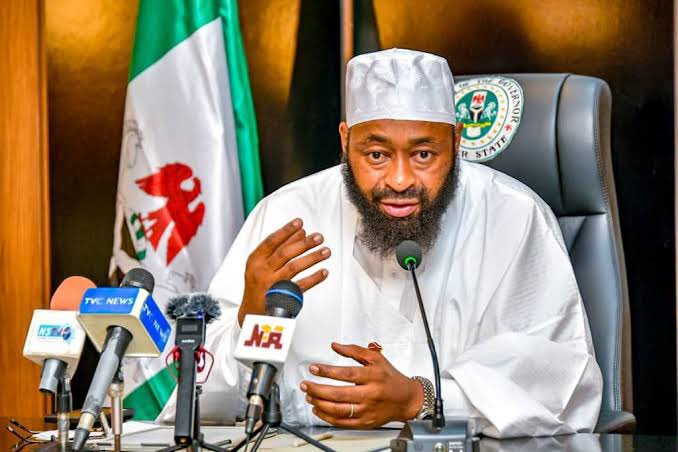

Niger State Governor, Umar Bago, has raised concern over the growing involvement of children in artisanal mining, saying some boys are abandoning school because they have become attracted to the money made from mining.
Bago said the situation had become a major challenge in the state, with some children reportedly choosing mining over education after experiencing the financial returns from the activity.
The governor spoke on Channels Television’s Sunday Politics, where he described artisanal mining as a menace requiring urgent intervention.
‘They Have Left Classrooms’
Bago said a UNICEF report covering Shiroro and other Local Government Areas in Niger State projected that there could be virtually no male pupils in Junior Secondary School Class 2 in some affected areas by 2027 if the trend continued.
He said many boys had already left classrooms to engage in artisanal mining.
“We know that gold mining in Niger State has become habitual,” the governor said.
He added, “The UNICEF report on Shiroro and other LGAs says by 2027, there will not be a single male child in Grade 8, that is JSS2… because all of them are into artisanal mining.
“They have left classrooms and are not in schools. This is a problem for us.”
‘They’ve Tasted The Mining Money’
According to Bago, one of the difficulties facing the government is convincing the children to return to school after they have started earning money from mining.
He said the financial attraction of the activity had made it difficult to persuade some of them to abandon mining sites.
“But these people, because they have tasted the mining money, cannot leave the site,” Bago said.
The governor said the situation was particularly worrying because communities that previously depended on farming were increasingly turning to mining.
He cited Shiroro as an example, saying the area was once largely agrarian but had seen residents abandon farming for mining.
“Shiroro used to be one of the biggest local governments that was agrarian, but they have abandoned farming for mining. It’s a menace, and there must be deliberate action,” he said.
Bago Seeks Federal Intervention
The governor said the state government needed stronger support from the Federal Government to tackle illegal and harmful mining activities.
He noted that the state government did not have direct control over security agencies and therefore could not unilaterally direct arrests or other enforcement operations against miners.
Bago called for an executive order from the Presidency and the Federal Ministry of Solid Minerals Development to prohibit mining in areas where the activity had become particularly problematic.
“We need decisive action,” he said.
“We need an executive order from the presidency, from the ministry of mineral resources, to ban mining in certain locations where we have seen they are problematic. Once that is done, it can be enforced.”
Mining, Logging And Poaching Linked
Bago also raised concerns about other activities taking place alongside illegal mining.
He said the problem went beyond digging for minerals, alleging that tree cutting, charcoal production, poaching and the sale of animal hides and timber were also taking place.
The governor further alleged that some foreign nationals were involved in financing and operating mining-related activities in the state.
“You have expatriates from other countries in our domain operating and funding these activities, and you are limited because you are constrained,” he said.
Concern Follows Deaths Of Suspected Miners
Bago’s comments came days after the deaths of 37 suspected illegal miners who had been arrested by the Nigeria Security and Civil Defence Corps in Niger State.
The suspects were among those arrested during operations around the Lt. Gen. Mohammed Inuwa Wushishi Estate in Minna on September 15 and 16.
Following the deaths, the Federal Government suspended the Niger State NSCDC Commandant, Suberu Aniviye, alongside 23 other officers, and ordered an investigation into the circumstances surrounding the incident.
The latest concerns have therefore placed renewed attention on the wider impact of illegal mining in Niger State, particularly its effect on education, agriculture, the environment and security.