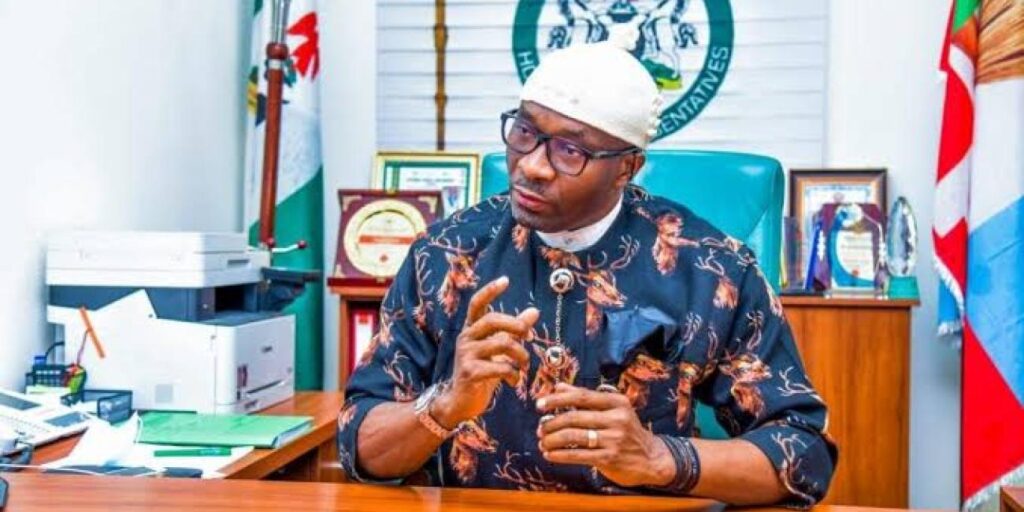

Deputy Speaker of the House of Representatives, Benjamin Kalu, has defended the controversial budget provision that earmarks ₦1 billion for the procurement of musical instruments for churches in Bende Federal Constituency, Abia State, insisting the allocation is meant for youth reorientation and social development programmes rather than the purchase of instruments alone.
In a statement issued by his Chief Press Secretary, Levinus Nwabughiogu, the Deputy Speaker’s office described reports surrounding the allocation as misleading, explaining that the intervention is designed to support youth-focused initiatives to be implemented through faith-based organisations.
The clarification comes after public backlash over revelations that the 2026 budget allocated ₦8.05 billion for the construction, renovation and equipping of churches and mosques across the country. Budget accountability organisation, Tracka, disclosed that ₦1.91 billion was allocated to church-related projects, while ₦6.14 billion was earmarked for mosque projects.
Among the controversial provisions is a budget line under the Federal Ministry of Labour and Employment’s Industrial Arbitration Panel, which allocated ₦1 billion for the provision and distribution of musical and cultural equipment to churches in Bende Local Government Area.
However, the Deputy Speaker’s office argued that the actual project value is about ₦780 million after deductions for Value Added Tax (VAT) and other statutory charges.
According to the statement, the programme will support more than 130 churches across Bende Federal Constituency, with each selected church expected to receive between ₦5 million and ₦6 million during the first phase of implementation.
Kalu’s explanation
The Deputy Speaker’s office explained that the intervention aims to strengthen churches’ ability to engage young people through programmes promoting moral values, character development, discipline, peace and community outreach.
It added that the funds would also cover the procurement of public address systems and evangelical equipment to support campaigns against drug abuse, sexual offences, violent crime and other social vices.
Defending the initiative, the office argued that nation-building should not focus solely on roads and physical infrastructure but should also include investments that promote moral values and positive behavioural change through trusted community institutions.
It further stated that the programme aligns with the Federal Government’s non-kinetic approach to addressing insecurity by promoting peace, unity and youth engagement, noting that similar interventions have previously been extended to traditional institutions through community projects.
The Deputy Speaker’s office also clarified that no money has been released for the project because implementation of the 2026 budget has not commenced.
It disclosed that a corrigendum has already been initiated through the Budget Office and the National Assembly’s Appropriation Committee to correct what it described as a technical error in the project’s description.
According to the statement, the intervention is not solely about providing musical instruments but about leveraging faith-based organisations to promote youth development, moral instruction and community cohesion across the constituency.