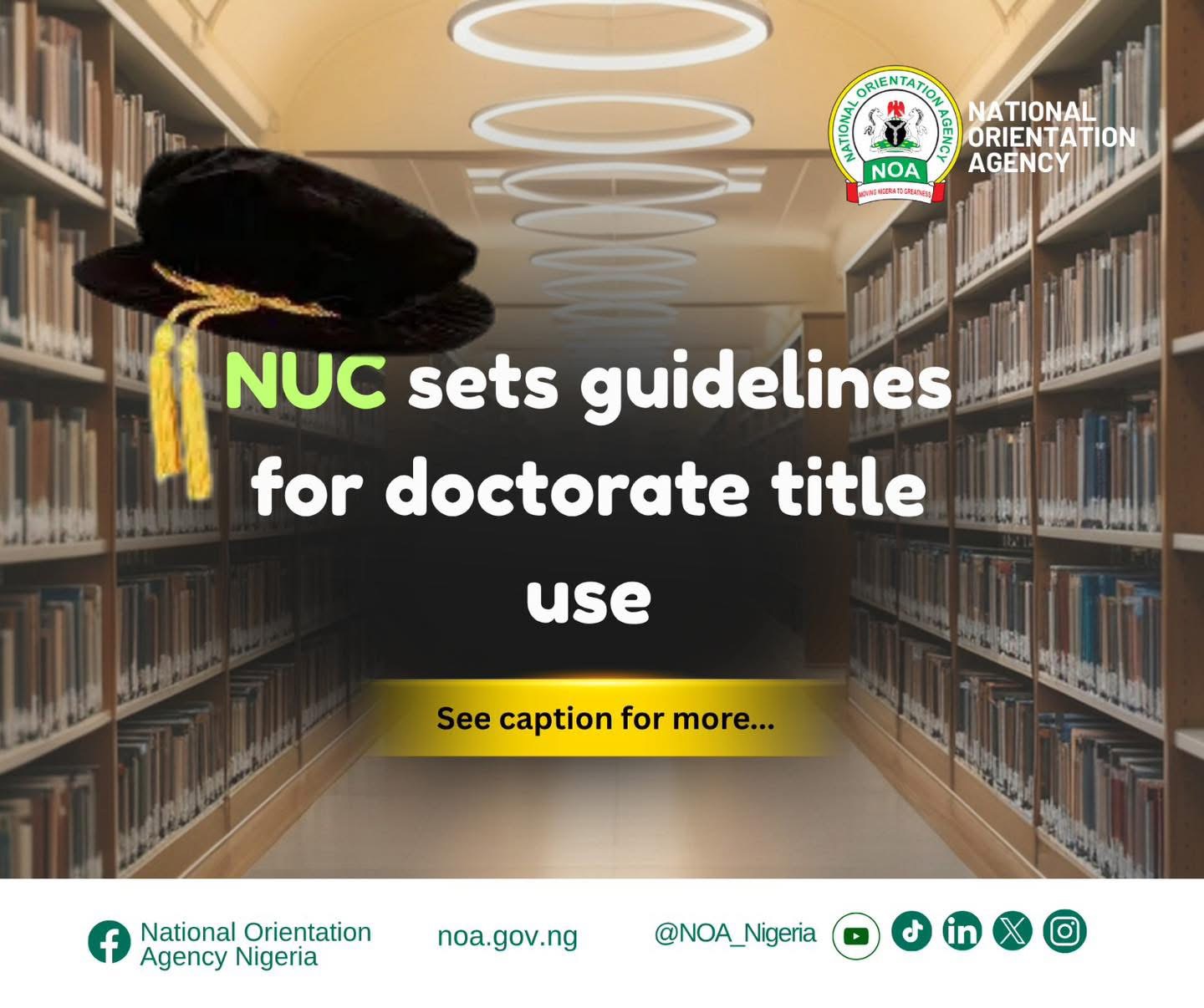

The National Universities Commission (NUC) has ordered Honorary Doctorate Awardees to stop using the ‘Dr’ title before their names.
The order, shared by the National Orientation Agency (NOA) comes as part of the NUC’s new policy to regulate the conferment of honorary degrees.
According to the NUC, the policy is;
“Aimed at curbing the “indiscriminate” distribution of titles, these rules ensure that academic honors remain a mark of true distinction rather than a commodity.”
The NUC stated that all honorary degree recipients are no longer permitted to use the title “Dr.” before their names. The regulator explained that the title of “Dr” is strictly reserved for earned academic PhDs and medical professionals.
Hence, honorary doctorate awardees are now expected to use the correct nomenclature after their names. For example, an honorary Doctor of Science (Honoris Causa) will now use D.Sc (H.C).
The NUC added that only approved universities that have graduated their first set of PhD students are eligible to award honorary degrees. Meanwhile, they are limited to awarding a maximum of three honorary degrees per convocation.
Additionally, honorary degrees must be awarded free of charge without any fee or expectation of donations from the recipients.
However, the NUC noted that self-nominated individuals and elected or appointed serving public officials are officially excluded from receiving these awards.
Furthermore, universities must publish the names of all recipients on their official websites. The institutions are also expected to implement a “Revocation Policy” that would allow them to withdraw awards if a recipient is convicted of fraud or unethical conduct.
The NUC also noted that an honorary degree does not grant the right to practice as a professional. It also doesn’t empower awardees to oversee administrative units or supervise research work in a university.
The regulator stressed that the guidelines are mandatory and noncompliance would attract sanctions.
That is;
Any university found violating these rules including awarding degrees to unqualified persons or exceeding the numerical limit will face appropriate regulatory sanctions.
“The Commission remains committed to protecting the global reputation and sanctity of the Nigerian University System,” the statement added.