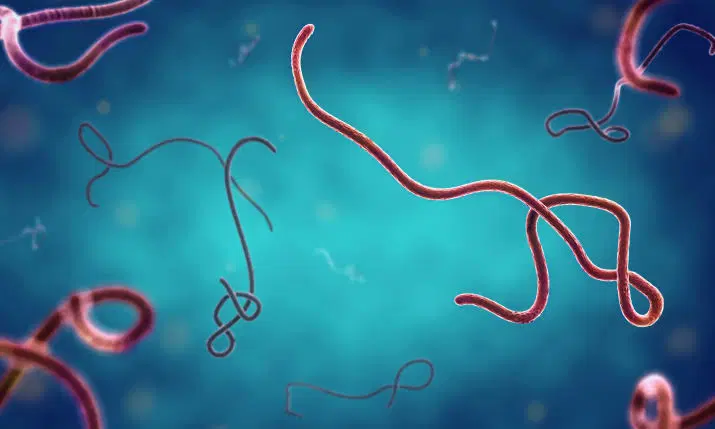

The World Health Organisation (WHO) has warned that there is currently no approved vaccine or specific treatment for the Bundibugyo strain of Ebola virus confirmed in Nigeria, as authorities intensify efforts to contain the infection.
Nigeria confirmed its first case of the strain on October 20 after a woman with a recent travel history to Uganda tested positive in Abuja.
According to the Federal Ministry of Health and Social Welfare, the patient developed symptoms on October 7, four days after arriving in Nigeria, and sought treatment at a private health facility on October 11.
She was subsequently transferred to an isolation facility for medical care, while laboratory tests confirmed the Bundibugyo strain.
The Nigeria Centre for Disease Control and Prevention (NCDC) said three rounds of molecular testing were conducted to identify the strain.
The patient, described by an official as a diplomat, reportedly developed multiple organ failure, raising concerns about the severity of her condition.
44 Contacts Identified For Monitoring
Health authorities have identified 44 people who may have been exposed to the patient, including healthcare workers, other patients, caregivers and travel-related contacts.
The Federal Ministry of Health, NCDC, FCT health authorities and international partners are coordinating contact tracing and strengthening infection prevention measures at the private hospital where she initially received care.
The Federal Government has also placed health institutions and port health surveillance units on high alert as investigations continue to establish where the woman contracted the virus.
The WHO has emphasised the importance of early detection, prompt isolation, contact tracing and strict infection prevention and control measures in containing the disease.
Although no approved vaccine or specific treatment is available for the Bundibugyo strain, supportive medical care remains essential for managing patients.
Uganda Seeks Patient’s Travel Records
Meanwhile, Uganda has asked Nigeria to provide detailed travel and clinical records of the infected woman to support investigations into the source of the infection.
Uganda’s Director-General of Health Services, Professor Charles Olaro, said the woman’s transit through the country did not establish that she contracted the virus there.
According to Uganda’s Ministry of Health, preliminary information indicated that the woman had travelled to eastern Democratic Republic of the Congo for business before transiting through Uganda in early October.
The Ugandan authorities said she reportedly showed no symptoms while passing through the country but developed them after arriving in Nigeria.
The ministry stressed that Uganda had no confirmed active Ebola cases as of the date of its statement and said it was awaiting further information from Nigeria to determine whether additional contact-tracing measures were necessary.
Nigeria’s Health Minister, Professor Muhammad Ali Pate, said both countries were collaborating to contain the risk.
He urged Nigerians to remain vigilant without panicking and advised the public to rely on verified information from health authorities rather than spread rumours.
National Assembly Demands Emergency Funding
The Senate and House of Representatives have called on the Federal Government to strengthen surveillance and emergency response measures following the confirmation of the case.
The lawmakers urged the relevant ministries and agencies to make health screening compulsory for arriving passengers at international airports, seaports and designated land borders.
The Senate also called for temperature and symptom checks, with enhanced screening for passengers who had visited or transited affected areas within the preceding 21 days.
It urged the Federal Government to release emergency funds to relevant agencies and equip entry points with trained port health officers, thermal scanners, protective equipment and isolation facilities.
Read also: Abuja Child Trafficking Suspect Admits Collecting ₦250,000 Per Child
The Senate further called for the amendment and re-enactment of the Quarantine Act, originally enacted in 1926, to provide a modern legal framework for responding to public health emergencies.
In the House of Representatives, lawmakers similarly demanded the immediate release of outstanding appropriated funds to strengthen surveillance, contact tracing, laboratory testing and other containment measures.
The House also urged health authorities to assess additional resources needed to improve the country’s preparedness and response capacity.
Atiku Demands Accountability For ₦10bn
Former Vice-President Atiku Abubakar has challenged President Bola Tinubu’s administration to account for the ₦10 billion reportedly announced for Ebola preparedness.
In a statement issued through Phrank Shaibu, Director of Strategic Communication of the African Democratic Congress Presidential Campaign Council, Atiku called for a public audit detailing the funds released, payments made, contracts awarded and supplies delivered.
He also questioned the preparedness of health facilities, alleging that the handling of the case exposed gaps in surveillance and the protection of frontline health workers.
Atiku said the government should explain the interval between the patient’s arrival in Nigeria, the onset of symptoms, her initial hospital visit and the public confirmation of the infection.
He, however, warned against using the outbreak as a justification for restricting political campaigns or voter participation.
As investigations continue, health authorities are working to establish the source of the infection, monitor identified contacts and prevent further transmission.